
Paper vs. Plastic in Food Packaging: Where Paper Works and Where It Doesn’t


Paper is becoming one of the most visible materials in the shift toward more sustainable food packaging.
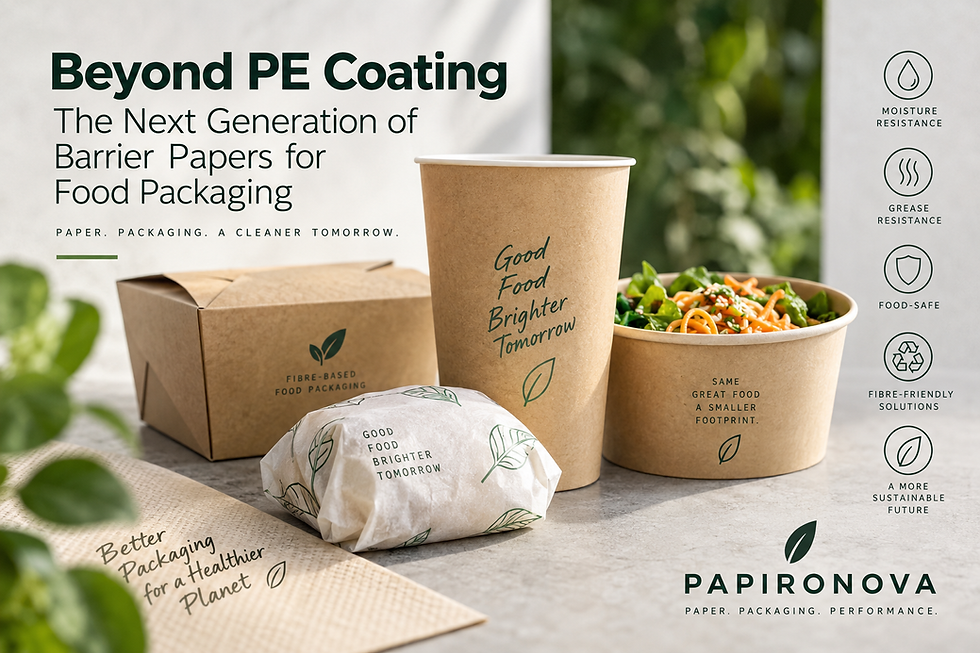
We see it everywhere. Takeaway boxes are replacing plastic containers. Paper wraps are becoming more common for burgers and sandwiches. Brands are experimenting with fibre-based cups, trays, lids and even packaging for products that were traditionally considered difficult to pack in paper.
This is an encouraging development, but there is also a simple reality that is sometimes lost in the sustainability discussion:
Paper is not the best material for every food package.
There are applications where paper performs extremely well. There are others where it needs a carefully selected barrier coating. And there are still situations where plastic, or a combination of materials, can provide better protection with less material.
Good packaging starts by understanding these differences.
Paper Has Many Natural Advantages
Paper and paperboard are already excellent packaging materials before any special barrier is added.
They are printable, foldable and easy to convert into many different shapes. Paperboard can provide excellent stiffness while remaining relatively lightweight, and its surface gives brands considerable freedom in printing and design.
Consumers also understand paper.
A paper box or wrap feels familiar, and in markets with established paper collection systems there is already an infrastructure for recovering fibre after use.
This makes paper a natural candidate for many food-packaging applications.
But the important question is where it works best.
Dry Foods Are a Natural Fit for Paper
Dry foods are among the easiest applications for paper and paperboard.
Think about pasta, rice, tea, cereals, confectionery, bakery products and many snack foods.
In these applications, the package often needs to provide mechanical protection, maintain its shape, carry product information and present the brand attractively.
Paperboard can do all of these very well.
When the product does not contain significant moisture or oil, the required barrier can also be relatively simple. This makes it possible to keep the packaging structure straightforward and fibre-rich.
Takeaway Food Is Another Strong Application
Food-service packaging is one of the areas where paper has particularly strong potential.
A burger box does not normally need to protect its contents for six months. It may only need to perform reliably from the restaurant counter to the point of consumption.
The same applies to many sandwich boxes, French-fries packs, bakery trays and takeaway meal containers.
This relatively short contact time can make a major difference.
With the right paperboard and barrier, paper packaging can handle many hot, moist and greasy foods very effectively.
The key words here are with the right barrier.
A dry sandwich and a hot meal covered in sauce may both be sold in paper packaging, but they place very different demands on the material.
Wrapping Paper Can Do More Than It Seems
A simple burger or sandwich wrap may look like one of the least complicated pieces of packaging.
In reality, the paper has several jobs to do at the same time.
It must fold easily around the food. It should resist grease long enough to keep the customer's hands and clothes clean. It should maintain enough strength when exposed to moisture and heat. It may also need excellent print quality and, of course, suitability for direct food contact.
Modern grease-resistant and barrier papers can achieve impressive results in these applications without requiring the heavy material structures used in more demanding packaging.
This is one area where intelligent material selection can make a significant difference.
Then We Come to Cups
Paper cups are a good example of why the discussion is more complicated than simply paper versus plastic.
The paperboard gives the cup its shape and stiffness.
But untreated paperboard cannot hold coffee or a cold drink for very long.
It needs a barrier.
Traditionally, this has often been provided by a PE coating. Today, manufacturers are developing dispersion coatings and other barrier technologies that can reduce the amount of conventional polymer and potentially improve compatibility with fibre-recycling processes.
So is a paper cup really paper?
Mostly, yes.
But the small functional layer can be just as important as the paperboard itself.
This is why the complete packaging structure matters more than the material people see from the outside.
Where Paper Starts to Struggle
Paper fibres naturally interact with water.
That is one of the fundamental technical challenges of fibre-based food packaging.
Once we move from relatively dry foods and short contact times to liquids, high moisture, significant amounts of oil or long shelf life, the job becomes more difficult.
The paper needs help.
That help normally comes from coatings, laminations or other functional layers.
And as the barrier requirements increase, the structure can become increasingly complex.
Shelf Life Changes Everything
There is a major difference between packaging a burger for the next 30 minutes and protecting food for the next six months.
Long shelf-life products may need protection against oxygen, moisture, water vapour, aroma loss, light and contamination.
These are demanding requirements.
Paper alone cannot provide all of them.
It may still form the main structural component of the package, but additional barrier technologies are usually required.
This is where simply replacing a plastic package with a paper version can become technically challenging.
A package has to protect the food first.
Liquids Are Particularly Demanding
Milk, juice, sauces and other liquid products present an even greater challenge.
The package must remain strong while in continuous contact with liquid. Seams must remain secure. Depending on the product, the structure may also need to protect against oxygen, light or microorganisms.
Paperboard can provide excellent structural strength, but it cannot normally perform all these functions by itself.
This is why many liquid packaging structures combine paperboard with other very thin functional layers.
The result may still contain a high proportion of fibre, but describing it simply as "paper packaging" does not tell the whole story.
And Sometimes Plastic Is Still Very Good at Its Job
Plastic has properties that are difficult to ignore.
It can provide excellent moisture resistance, strong sealing, flexibility and high barrier performance while using very little material.
For some foods, particularly those requiring long shelf life or very demanding protection, plastic can still be technically efficient.
That does not mean the existing packaging cannot be improved.
Plastic structures can often be simplified, made thinner or redesigned for better recyclability. Unnecessary layers can be removed. In some cases, paper can replace part of the structure.
The objective should not be to remove plastic at any cost.
The objective should be to use materials intelligently.
A Paper Package Can Still Contain Plastic
This is worth saying clearly because it is often misunderstood.
A package can look completely like paper and still contain a polymer barrier.
A conventional PE-coated paper cup is a simple example.
The paper provides the structure. The PE provides liquid resistance and helps with sealing.
New barrier technologies are allowing manufacturers to reduce conventional plastic content considerably in some applications, but terms such as "paper-based", "plastic-free", "recyclable" and "compostable" do not mean the same thing.
Each claim needs to be considered separately and supported appropriately.
Recycling Is About the Whole Package
Another mistake is to look only at the percentage of paper.
Imagine a package that contains 90 percent paper by weight.
That sounds excellent.
But what is the remaining 10 percent? How is it attached? Can the fibres be separated effectively during repulping? What happens to the barrier layer? Is the finished package actually collected through the paper stream in the country where it is sold?
These questions matter.
Coatings, laminations, adhesives, printing inks, wet-strength additives and food contamination can all affect the recycling process.
This is why recyclability should be considered for the finished package, not simply for the base paper.
We Also Need to Talk About Food Waste
There is another part of the sustainability discussion that deserves more attention.
The environmental purpose of packaging is not only to minimize the package itself. Packaging also protects the product inside.
If changing the packaging causes food to spoil faster, leak during transport or arrive damaged, the result may be worse rather than better.
Imagine saving a few grams of packaging material but losing the food inside.
That is not an efficient solution.
Good packaging uses enough material to do its job properly, but no more than necessary.
So, Paper or Plastic?
In many cases, this is actually the wrong question.
A better question is:
What does this food need from its packaging?
Does it need protection for 30 minutes or six months?
Is it dry or wet?
Hot or frozen?
Oily or acidic?
Does it need an oxygen barrier?
Will the package be heat sealed?
How will it be transported?
And what happens to the package after the customer has finished using it?
Once these questions are answered, the material decision becomes much more logical.
The Future Will Probably Use Both, More Intelligently
We do not believe the future of food packaging is simply paper replacing plastic everywhere.
The more realistic direction is smarter material use.
Paper will continue replacing conventional plastic in applications where fibre-based structures can provide the required performance efficiently.
Barrier coatings will continue improving, allowing paper to enter applications that were previously difficult.
At the same time, plastic will remain useful where a very thin layer can provide a function that would otherwise require a much more complicated structure.
The interesting innovation is happening between these two worlds.
The goal is to maximize useful fibre, minimize unnecessary materials and make every layer of the package perform a clear function.
Start With the Food
At Papironova, we prefer to start with the application rather than deciding on the material first.
Tell us what you are packing.
Tell us whether it is hot, cold, dry, wet, oily or frozen.
Tell us how long it needs to stay protected, how the packaging will be filled and sealed, how it will be transported and where it will eventually be sold.
Then we can look at the material.
Depending on the application, that may be an uncoated paper, a grease-resistant wrapping paper, coated FBB, kraft-back board, cupstock, dispersion-coated paper or a more sophisticated barrier structure.
Sometimes the best solution is almost entirely fibre-based.
Sometimes a small functional layer makes the entire package work.
What matters is understanding why each material is there.
Better Packaging Starts With Better Questions
The transition toward more fibre-based food packaging is real, and it creates enormous opportunities.
But sustainability should not become a competition between materials.
Paper has remarkable advantages. Plastic has useful properties too. Barrier technology is increasingly allowing us to combine performance with significantly more fibre-based structures.
The best packaging solution is the one that protects the food properly, uses materials efficiently, works reliably on the converting and filling line, meets regulatory requirements and has a realistic route after use.
That is a more complicated story than simply saying "paper is better than plastic."
But it is also a much more useful one.
Papironova | Paper. Packaging. Performance.


Comments