
Beyond PE Coating: The Next Generation of Barrier Papers for Food Packaging

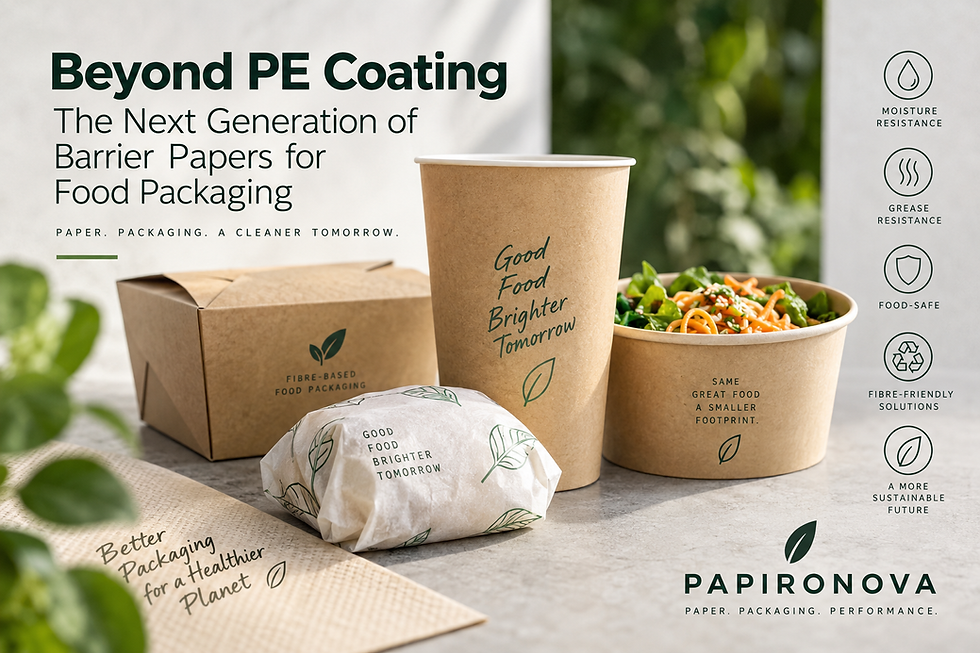
For decades, polyethylene (PE) coating has been one of the standard solutions for giving paper and paperboard the moisture and grease resistance required in food packaging.
It is effective, familiar and widely available. But packaging requirements are changing.
Brand owners, food-service operators, converters and retailers are increasingly looking for fibre-based packaging structures that combine reliable barrier performance with improved recyclability and reduced dependence on conventional plastic layers.
This is accelerating the development of a new generation of barrier papers and coated paperboards.
Why Does Paper Need a Barrier?
Paper is naturally porous and hydrophilic. On its own, it cannot provide sufficient protection for many food applications involving moisture, oil, grease or liquid.
The required barrier depends heavily on the application.
A burger wrap must resist grease. A takeaway box may need resistance to both oil and moisture. A paper cup must contain liquid for a defined period and withstand elevated temperatures. Frozen-food packaging faces completely different conditions, while dairy and other sensitive products can require significantly more demanding barrier structures.
This is why there is no universal coating that can simply replace PE in every food-packaging application.
The right solution starts with understanding the packed product and its real operating conditions.
Moving Beyond Conventional PE Coatings
Traditional PE extrusion coating creates a highly effective continuous layer over the paper surface. Its performance is one reason it has remained so widely used.
The challenge is what happens after use.
Depending on coating weight, structure, local collection systems and recycling technology, polymer-coated paper can be more difficult to process within conventional paper-recycling streams.
New barrier technologies therefore aim to provide the necessary functionality while reducing the amount of conventional polymer used or improving the compatibility of the finished packaging with fibre-recovery processes.
Several technologies are becoming increasingly important.
1. Water-Based and Dispersion Barrier Coatings
Water-based dispersion coatings are among the most promising developments for many fibre-based food-packaging applications.
Instead of applying a relatively thick extruded plastic film, a functional coating is applied to the paper or board surface and dried to create the required barrier.
Depending on the formulation and application, these coatings can provide resistance to:
Water and moisture
Oil and grease
Water vapour
Food staining
Certain liquids
Some systems can also provide heat-sealing properties required for converting and forming finished packaging.
A key advantage is the possibility of achieving the required performance with a relatively low coating weight while designing the finished structure with fibre recovery in mind.
However, “water-based” does not automatically mean plastic-free, biodegradable or recyclable everywhere. The chemistry, coating weight, substrate and final packaging structure all matter.
2. Grease-Resistant Barrier Papers
Grease resistance is particularly important for fast food, bakery products and takeaway packaging.
Applications include burger and sandwich wraps, bakery papers, tray liners, French-fries packaging and various food-service formats.
Modern grease-barrier technologies can reduce reliance on traditional fluorinated grease-resistant treatments while maintaining the functionality required during actual food contact.
For buyers, the important question is not simply whether a paper is described as “greaseproof.”
Performance should be specified according to the food, contact duration, temperature and converting process.
3. Bio-Based and Renewable Barrier Technologies
Another development area involves coatings and functional layers derived partly or predominantly from renewable resources.
Possible technologies include modified starches, cellulose-based materials, biopolymers and other bio-derived coating systems.
These technologies are developing rapidly, but the term “bio-based” should be treated carefully.
A renewable raw-material origin does not by itself guarantee recyclability, compostability or suitability for a particular food-contact application.
Each structure must be evaluated according to its actual composition and intended end-of-life route.
4. High-Barrier Fibre-Based Structures
Some applications require considerably more than basic grease or moisture resistance.
Packaging may need to control oxygen transmission, water vapour, aroma or other interactions between the packed product and the surrounding environment.
In these applications, advanced multilayer fibre-based structures may combine specially engineered paper or board with very thin functional layers.
The objective is increasingly to achieve the necessary product protection while maximizing fibre content and minimizing materials that could interfere with recovery and recycling.
This is particularly relevant as the industry works toward more demanding applications that have historically depended heavily on plastic laminates.
Recyclable Does Not Mean Barrier-Free
One of the most important misconceptions in sustainable packaging is that eliminating a conventional plastic layer automatically creates a better package.
Packaging has a primary function: protecting the product.
If insufficient barrier performance causes leakage, contamination, reduced shelf life or increased food waste, the environmental benefit of reducing packaging material can quickly become questionable.
The goal should therefore not be to eliminate barriers.
It should be to use the right barrier, in the right quantity, on the right fibre substrate, while considering how the complete packaging structure performs during use and at end of life.
The Base Paper Matters Just as Much as the Coating
Barrier performance cannot be evaluated independently from the paper or paperboard underneath it.
Important substrate characteristics include:
Grammage
Bulk
Stiffness
Surface smoothness
Porosity
Cobb value and water absorption
Formation
Printability
Creasing and folding behaviour
Dimensional stability
The same coating can behave differently when applied to different substrates.
For formed containers, cups and complex food-service packaging, the interaction between board, coating, printing, creasing, sealing and forming becomes particularly important.
This is why material selection should consider the entire converting process—not simply the coating specification.
Matching the Barrier to the Application
Different food-packaging applications require different performance profiles.
A paper used for a dry bakery product does not need the same structure as a noodle bowl containing hot liquid. A cold-drink cup presents different challenges from a burger wrap, and a frozen-food carton operates under very different conditions from a takeaway meal box.
Before specifying a barrier paper, buyers and converters should consider:
What will be packed?
Is the product dry, wet, oily, acidic, frozen or hot?
At what temperature will filling and consumption occur?
Hot-fill and hot-food applications can behave very differently from ambient applications.
How long is the required contact time?
Minutes of food-service contact and months of shelf life are fundamentally different requirements.
What converting process will be used?
Printing, die-cutting, creasing, folding, forming, gluing and heat sealing can all influence material selection.
What is the intended end-of-life route?
The complete structure should be assessed against the relevant collection and recycling infrastructure in the target market.
Food-Contact Compliance Remains Essential
Sustainability claims cannot replace food-safety requirements.
Every barrier system intended for direct or indirect food contact must be evaluated for its specific application and target market.
For European applications, material selection should therefore be supported by appropriate documentation, testing and declarations relating to the intended food-contact conditions.
The exact requirements depend on the material structure, food type, temperature, contact duration and applicable legislation.
Claims such as “plastic-free,” “PFAS-free,” “recyclable,” “compostable” or “bio-based” should likewise be made only when they can be properly substantiated for the specific product and market.
The Future Is Application-Specific
The transition beyond conventional PE coating is unlikely to be driven by one universal replacement technology.
Instead, the market is moving toward more application-specific structures.
For relatively simple applications, a lightweight dispersion barrier may provide sufficient performance. Other applications may require advanced multilayer solutions. In some cases, conventional polymer coatings may still provide the most technically appropriate solution until an alternative can deliver comparable functionality, safety and end-of-life performance.
The important change is therefore not simply replacing one coating with another.
It is designing the complete packaging structure more intelligently.
How Papironova Approaches Barrier Packaging
At Papironova, we look at barrier paper as part of the complete packaging system.
The substrate, coating, food-contact conditions, converting process, required barrier performance and intended end-of-life route need to work together.
For food-service and food-packaging projects, we can evaluate requirements across paper and paperboard substrates, coated structures and finished packaging applications.
If you are developing a new fibre-based package or evaluating an alternative to conventional PE-coated paper, start with the application rather than the coating name.
Tell us:
What food or beverage will be packed
Filling and use temperature
Required contact time or shelf life
Required resistance to water, oil, grease or vapour
Printing and converting process
Target packaging format
Destination market and compliance requirements
Intended recycling or end-of-life route
From there, the appropriate material structure can be evaluated.
Papironova — Paper. Packaging. Performance.
For technical enquiries and material-development projects, contact our team at Papironova.


Comments